

2025-11-07

GFP Fluorescence Screening in Transgenic Roots with LUYOR-3415RG

In a study published in Antioxidants (Wang et al., 2023), researchers from Nanjing Agricultural University investigated the role of the BcWRKY22 transcription factor in enhancing thermotolerance in non-heading Chinese cabbage (Brassica campestris ssp. chinensis). To verify the successful generation of transgenic hairy roots overexpressing BcWRKY22, the team used the LUYOR-3415 fluorescent protein excitation lamp for GFP visualization.

Abstract

WRKY transcription factors (TFs) participate in plant defense mechanisms against biologi- cal and abiotic stresses. However, their regulatory role in heat resistance is still unclear in non-heading Chinese cabbage. Here, we identified the WRKY-IIe gene BcWRKY22 (BraC09g001080.1), which is activated under high temperatures and plays an active role in regulating thermal stability, through transcriptome analysis. We further discovered that the BcWRKY22 protein is located in the nucleus and demonstrates transactivation activity in both the yeast and plant. Additionally, our studies showed that the transient overexpression of BcWRKY22 in non-heading Chinese cabbage activates the expression of catalase 2 (BcCAT2), enhances CAT enzyme activity, and reduces Hydrogen Peroxide (H2O2) accumulation under heat stress conditions. In addition, compared to its wild-type (WT) counterparts, Arabidopsis thaliana heterologously overexpresses BcWRKY22, improving thermotolerance. When the BcWRKY22 transgenic root was obtained, under heat stress, the accumulation of H2O2 was reduced, while the expression of catalase 2 (BcCAT2) was upregulated, thereby enhancing CAT enzyme activity. Further analysis revealed that BcWRKY22 directly activates the expression of BcCAT2 (BraC08g016240.1) by binding to the W-box element distributed within the promoter region of BcCAT2. Collectively, our findings suggest that BcWRKY22 may serve as a novel regulator of the heat stress response in non-heading Chinese cabbage, actively contributing to the establishment of thermal tolerance by upregulating catalase (CAT) activity and downregulating H2O2 accumulation via BcCAT2 expression.

Visualizing GFP in NHCC Roots with LUYOR-3415RG Fluorescent Protein Excitation Lamp

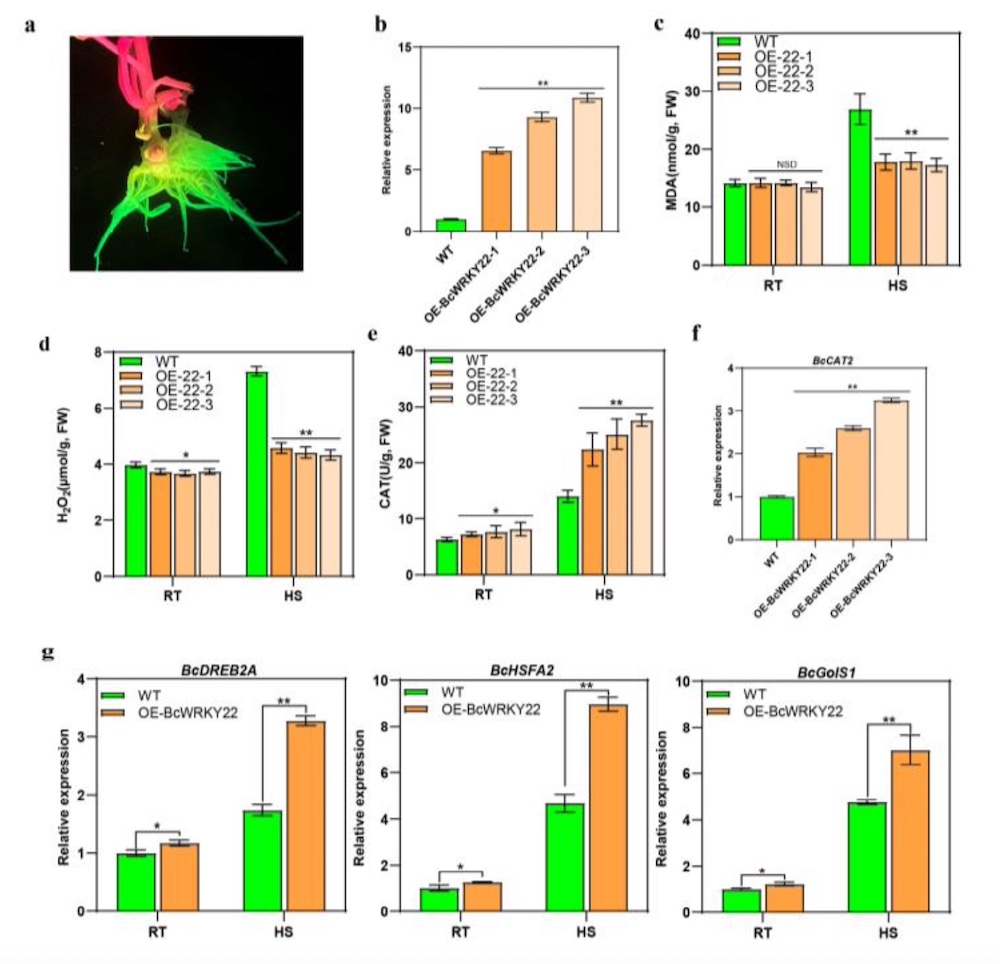
Since the expression of BcWRKY22 was at its highest in roots (Figure 1c), we obtained transgenic roots using Agrobacterium rhizogenes in NHCC, and the GFP fluorescence of roots was observed with LUYOR-3415RG Fluorescent Protein Excitation Lamp, to ensure that BcWRKY22-overexpressed roots were obtained (Figure 5a).

An RT-qPCR analysis showed that BcWRKY22 was overexpressed in the three root systems (OE-BcWRKY22-1, OE-BcWRKY22-2, and OE-BcWRKY22-3), and their gene expression levels were higher than that of the WT control (Figure 5b). Then, we treated the WT control and the three over-expressed roots with heat stress (HS). The overexpression of BcWRKY22 in the three root systems did not affect their MDA content values at 24 ◦C, while the values of MDA were significantly higher in the WT control than in the BcWRKY22-overexpressed roots under HS (Figure 5c). Meanwhile, we found that the H2O2 content values of the three transgenic roots were lower than that of the WT control at 24 ◦C, and the increased degree of H2O2 content values in the three transgenic roots was markedly lower than that of the WT control after HS (Figure 5d). This conclusion is compatible with the results of the transient expression and overexpression in Arabidopsis thaliana, indicating that the overexpression of BcWRKY22 can affect the content of H2O2. Furthermore, the CAT activity of the BcWRKY22-overexpressedroot systems was higher at 24 C than that of the WT control. After HS, compared withthe WT control, the increase in CAT activity in the BcWRKY22-overexpressed roots was significantly upregulated (Figure 5e). In addition, the expression of BcCAT2 was significantly increased in the BcWRKY22-overexpressed roots (Figure 5f).

In order to further confirm that the over expression of BcWRKY22 can improve the thermotolerance of roots, we determined the expression levels of the heat response genes BcDREB2A, BCHSFA2, and BcGolS1. Their expression levels increased significantly in transgenic roots. Moreover, after HS, the expression of the three genes increased even more (Figure 5g). In summary, these results suggest that BcWRKY22 overexpression improves the thermo tolerance of transgenic roots. At thes ame time, BcWRKY22 may regulate the expression level of BcCAT2 to improve CAT activityand reduce the accumulation of H2O2.

Photo below: GFP fluorescence of the NHCC roots observed by LUYOR-3415RG Fluorescent Protein Excitation Lamp
GFP fluorescence in nhcc roots captured by luyor-3415rg

Reference

Wang, H., Gao, Z., Chen, X., Li, E., Li, Y., Zhang, C., & Hou, X. BcWRKY22 activates BcCAT2 to enhance catalase (CAT) activity and reduce hydrogen peroxide (H₂O₂) accumulation, promoting thermotolerance in non-heading Chinese cabbage (Brassica campestris ssp. chinensis). Antioxidants 12, 1710 (2023).


Tags:

Whatsapp

Skype

Send Inquiry

We use cookie to improve your online experience. By continuing to browse this website, you agree to our use of cookie.

Cookies

Please read our Terms and Conditions and this Policy before accessing or using our Services. If you cannot agree with this Policy or the Terms and Conditions, please do not access or use our Services. If you are located in a jurisdiction outside the European Economic Area, by using our Services, you accept the Terms and Conditions and accept our privacy practices described in this Policy.
We may modify this Policy at any time, without prior notice, and changes may apply to any Personal Information we already hold about you, as well as any new Personal Information collected after the Policy is modified. If we make changes, we will notify you by revising the date at the top of this Policy. We will provide you with advanced notice if we make any material changes to how we collect, use or disclose your Personal Information that impact your rights under this Policy. If you are located in a jurisdiction other than the European Economic Area, the United Kingdom or Switzerland (collectively “European Countries”), your continued access or use of our Services after receiving the notice of changes, constitutes your acknowledgement that you accept the updated Policy. In addition, we may provide you with real time disclosures or additional information about the Personal Information handling practices of specific parts of our Services. Such notices may supplement this Policy or provide you with additional choices about how we process your Personal Information.


Cookies

Cookies are small text files stored on your device when you access most Websites on the internet or open certain emails. Among other things, Cookies allow a Website to recognize your device and remember if you've been to the Website before. Examples of information collected by Cookies include your browser type and the address of the Website from which you arrived at our Website as well as IP address and clickstream behavior (that is the pages you view and the links you click).We use the term cookie to refer to Cookies and technologies that perform a similar function to Cookies (e.g., tags, pixels, web beacons, etc.). Cookies can be read by the originating Website on each subsequent visit and by any other Website that recognizes the cookie. The Website uses Cookies in order to make the Website easier to use, to support a better user experience, including the provision of information and functionality to you, as well as to provide us with information about how the Website is used so that we can make sure it is as up to date, relevant, and error free as we can. Cookies on the Website We use Cookies to personalize your experience when you visit the Site, uniquely identify your computer for security purposes, and enable us and our third-party service providers to serve ads on our behalf across the internet.

We classify Cookies in the following categories:
 ●  Strictly Necessary Cookies
 ●  Performance Cookies
 ●  Functional Cookies
 ●  Targeting Cookies


Cookie List
A cookie is a small piece of data (text file) that a website – when visited by a user – asks your browser to store on your device in order to remember information about you, such as your language preference or login information. Those cookies are set by us and called first-party cookies. We also use third-party cookies – which are cookies from a domain different than the domain of the website you are visiting – for our advertising and marketing efforts. More specifically, we use cookies and other tracking technologies for the following purposes:

Strictly Necessary Cookies
These cookies are necessary for the website to function and cannot be switched off in our systems. They are usually only set in response to actions made by you which amount to a request for services, such as setting your privacy preferences, logging in or filling in forms. You can set your browser to block or alert you about these cookies, but some parts of the site will not then work. These cookies do not store any personally identifiable information.

Functional Cookies
These cookies enable the website to provide enhanced functionality and personalisation. They may be set by us or by third party providers whose services we have added to our pages. If you do not allow these cookies then some or all of these services may not function properly.

Performance Cookies
These cookies allow us to count visits and traffic sources so we can measure and improve the performance of our site. They help us to know which pages are the most and least popular and see how visitors move around the site. All information these cookies collect is aggregated and therefore anonymous. If you do not allow these cookies we will not know when you have visited our site, and will not be able to monitor its performance.

Targeting Cookies
These cookies may be set through our site by our advertising partners. They may be used by those companies to build a profile of your interests and show you relevant adverts on other sites. They do not store directly personal information, but are based on uniquely identifying your browser and internet device. If you do not allow these cookies, you will experience less targeted advertising.

How To Turn Off Cookies
You can choose to restrict or block Cookies through your browser settings at any time. Please note that certain Cookies may be set as soon as you visit the Website, but you can remove them using your browser settings. However, please be aware that restricting or blocking Cookies set on the Website may impact the functionality or performance of the Website or prevent you from using certain services provided through the Website. It will also affect our ability to update the Website to cater for user preferences and improve performance. Cookies within Mobile Applications

We only use Strictly Necessary Cookies on our mobile applications. These Cookies are critical to the functionality of our applications, so if you block or delete these Cookies you may not be able to use the application. These Cookies are not shared with any other application on your mobile device. We never use the Cookies from the mobile application to store personal information about you.

If you have questions or concerns regarding any information in this Privacy Policy, please contact us by email at . You can also contact us via our customer service at our Site.